Las Vegas Monsoon Car Care: Before & After a Storm | Flex Details
Overview
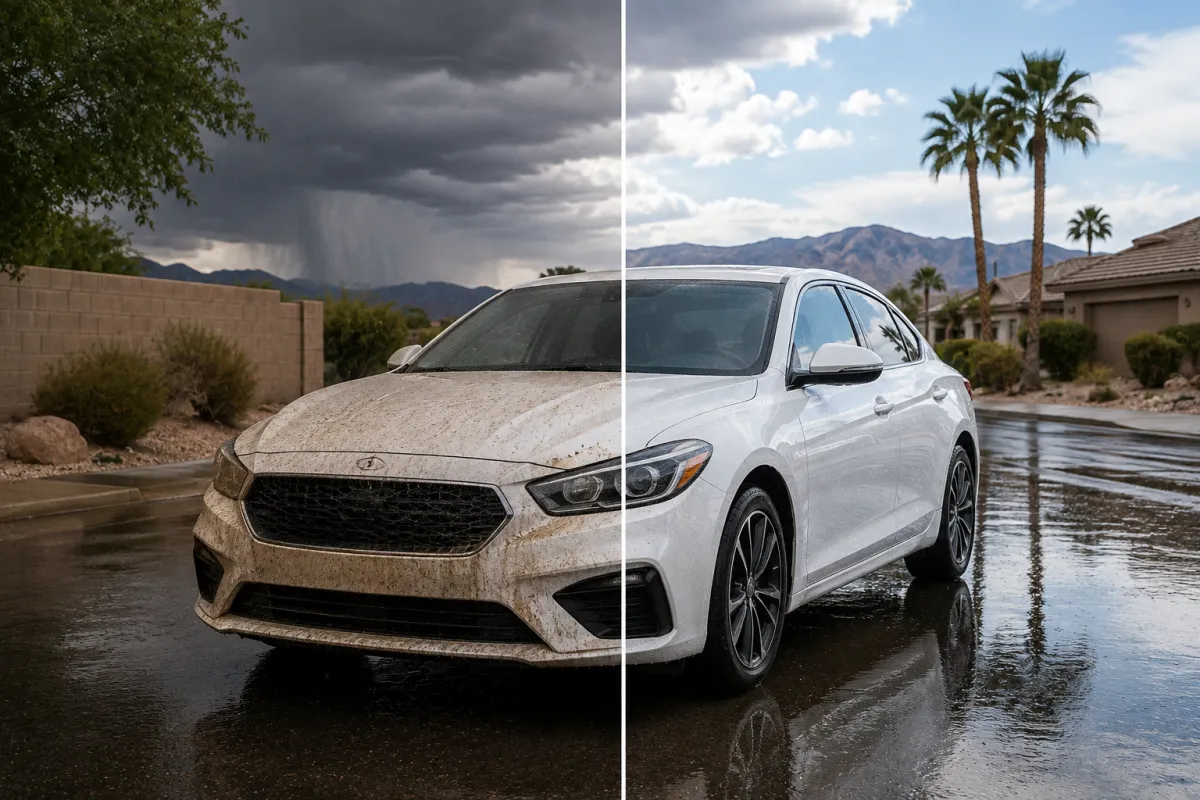
Monsoon season in the Las Vegas Valley runs from roughly mid-June through the end of September, and the rain it brings is the most damaging water your paint sees all year. Airborne dust mixes with rainfall and dries into an alkaline film that begins etching clear coat within days in 100 degree heat. The fix is straightforward but time-sensitive: rinse and dry the vehicle within 48 hours of a storm, and never let monsoon rain air-dry on the paint. Everything else in this guide is detail around that one rule.
Storm just rolled through? Flex Details comes to your driveway anywhere in Henderson, Green Valley, Summerlin, or Anthem. Get a free quote and we will handle the cleanup.
Why Monsoon Rain Damages Paint More Than Regular Rain
Dust-loaded rainfall and alkaline residue
A monsoon storm here almost always starts with wind, and wind in the Mojave means airborne dust. By the time the rain falls it is already carrying a heavy load of suspended mineral particles. What lands on your hood is not clean water, it is dilute alkaline slurry.
That matters because most people think of rain as a free rinse. In the Vegas Valley it is closer to the opposite. Rain in a coastal city washes contamination off. Rain here deposits it, then leaves it behind when the water goes.
Flash-drying in 100 degree heat and mineral etching
The second half of the problem is what happens next. Monsoon storms in Henderson and Summerlin typically clear fast, the sun comes back, and surface temperatures climb into the 130 to 160 degree range within an hour.
Water sitting on that surface does not evaporate slowly. It flashes off, and every dissolved mineral in it concentrates into a hard deposit right where the droplet sat. On hot paint, those deposits start bonding almost immediately, and within a few days they begin etching into the clear coat. That is why the spots after a monsoon storm are so much harder to remove than ordinary water spots, and why a week of neglect can turn a wash into a polish job.
Before the Storm
Why a protected surface releases monsoon residue and bare paint holds it
The single best monsoon preparation is having something on the paint. A ceramic coating or a good sealant creates a slick, hydrophobic surface that mineral residue struggles to bond to. After a storm, protected paint usually cleans up with a rinse and a dry. Bare paint holds onto the residue, and getting it off takes chemical decontamination and sometimes machine work.
This is the practical argument for protection in this climate that has nothing to do with gloss. It turns a two-hour recovery into a fifteen-minute one, several times a season.
What to do with a boat, RV, or off-road vehicle sitting outside
Anything large parked outside takes the same hit with more surface area and usually less attention. RVs and boats collect monsoon residue on horizontal surfaces where it pools, and roofs are the worst offender since nobody looks at them.
Before monsoon season starts, get a UV sealant on the fiberglass and gelcoat, check that roof seams and lap sealant are intact, and make sure any cover you use is actually secured. A cover that flaps in monsoon wind sands your finish for you.
Want protection on before the next storm? Get a free quote and Flex Details will get you sorted, whether it is a daily driver, an RV, or a boat on the trailer.
After the Storm: The 48-Hour Window
The rinse and dry rule, and why a drive-through wash makes it worse
Aim to rinse within 48 hours, and dry it rather than letting it air-dry. Air-drying reproduces the exact problem the storm created, just with tap water, and Nevada tap water is mineral-heavy enough to leave its own spots.
Skip the drive-through. Automated washes use spinning brushes or cloth that carry grit from every vehicle before yours, and running that across paint still coated in abrasive monsoon dust is how you get a hood full of swirl marks. If you are washing it yourself, use two buckets, rinse the mitt often, and dry with clean microfiber.
When residue has already etched and needs correction
If the spots do not come off with a wash, they are no longer sitting on the surface. At that point the sequence is chemical decontamination first, then a clay treatment, and if the etching has gone into the clear coat, a machine polish to level it out.
The good news is that most monsoon etching is shallow and comes out with a light polish. The bad news is that it keeps getting deeper the longer it sits, and a season of ignored storms can add up to real correction work. If you can still see spots after two washes, it is worth having someone look at it.
Frequently Asked Questions
When is monsoon season in Las Vegas?
Monsoon season in the Las Vegas Valley generally runs from mid-June through the end of September, with the most active period usually falling in late July through August. Storms tend to build in the afternoon, arrive fast with wind and dust ahead of the rain, and clear quickly. Any given year can be heavier or lighter, but the paint risk is the same whenever storms do hit.
Is monsoon rain actually bad for car paint?
Yes, more than ordinary rain. Monsoon rainfall carries suspended desert dust, which is alkaline and mineral-heavy, and it flash-dries on hot paint into concentrated deposits. Those deposits bond quickly and begin etching clear coat within days. Rain in most climates is roughly neutral. In the Mojave it is a contaminant delivery system.
Should I wash my car before or after a monsoon storm?
After, and within 48 hours. Washing right before a storm accomplishes nothing since the vehicle gets recoated immediately. What does help beforehand is having protection on the paint, a sealant or ceramic coating, so post-storm residue rinses off rather than bonding. Then wash and dry once the weather clears.
Does ceramic coating protect against monsoon residue?
It helps significantly, though it is not a force field. A ceramic coating gives you a slick, hydrophobic surface that mineral residue has a much harder time bonding to, which means post-storm cleanup is usually a rinse and dry instead of a decontamination job. You still need to wash it. You just need far less work to get back to clean, and you avoid the etching that leads to correction.
Monsoon cleanup, protection before the next storm, or correction on spotting that has already set in, Flex Details offers free quotes across Henderson, Summerlin, and the Las Vegas Valley. Reach out and we will come to you.