New Car in Las Vegas? The First 90 Days Matter | Flex Details
Overview
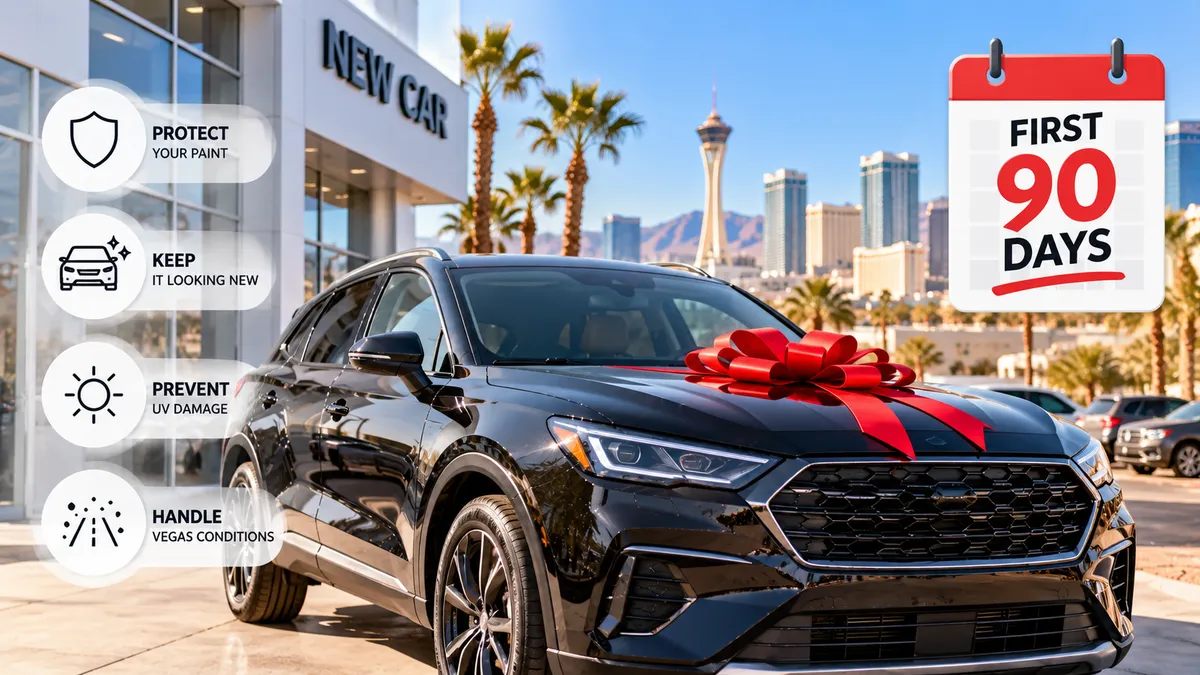
New car paint protection in Las Vegas matters sooner than most owners expect, because factory clear coat starts oxidizing under Vegas Valley UV within the first summer, and dealer prep washes frequently put swirl marks in the paint before the car is even delivered. The first 90 days are the cheapest window to protect a new vehicle, since the paint has not been damaged yet and no correction is needed. A proper new vehicle prep includes a full decontamination, a light polish to remove any dealer-installed swirls, and a long-term sealant or coating. Do it early and you are protecting paint instead of repairing it later.
Protect it while it is still new. Flex Details comes to your driveway in Henderson and across the Las Vegas Valley. Get a free quote to get started.
Your New Car Probably Already Has Swirl Marks
What dealer prep washes do to factory clear coat
Before a new vehicle is handed over, it goes through dealer prep. The car arrives off a transport truck covered in shipping film residue, rail dust, and road grime, and it gets washed quickly so it looks good on the lot and on delivery day. Speed is the priority. That often means shared wash mitts, dirty towels, automatic brushes, or a dry wipe-down to knock off dust between showings.
Every one of those puts fine scratches in the clear coat. In a dealership showroom under diffused lighting, you will never see them. Out in the Las Vegas sun, you will. They show up as circular spider webs around a bright reflection, and they are most obvious on black, dark gray, and dark blue paint.
None of this means the dealer did anything unusual. It is simply how high-volume lot prep works. It does mean that "new" and "perfect" are not the same thing when it comes to paint.
How to check your paint in the sun before you sign
You can check this yourself in about two minutes. Before you finalize paperwork, ask to see the vehicle outside in direct sunlight. Stand so the sun reflects off the hood, roof, or a door panel, and look at the area right around the reflection. Swirl marks show up as fine circular lines that seem to orbit the bright spot.
Also run the back of your fingers lightly across the hood and the top of the doors. If the paint feels gritty instead of glassy, there is bonded contamination on it from transport and lot storage. Neither issue is a reason to walk away from a car you want, but it is good to know exactly what condition the paint is in on day one.
Why the First Summer Is the One That Counts
Factory clear coat and Vegas Valley UV
Clear coat is the layer that protects the color underneath from UV. In most climates it holds up for years before it starts to show wear. In the Las Vegas Valley, where there is little cloud cover, almost no humidity, and summer heat over 115 degrees, unprotected clear coat starts to oxidize within the first summer.
The early signs are subtle. The paint loses some of its depth, horizontal panels like the roof and hood look a little flat compared to the doors, and water starts to sit on the surface instead of beading and running off. By the time you notice fading, the clear coat has already been breaking down for a while.
Parking matters, but it does not solve the problem. A car that lives in a Henderson garage still spends hours a day in open parking lots at work, the grocery store, and the gym. That exposure adds up quickly.
The cheapest protection window is before damage starts
Here is the part most new owners do not hear. Protecting paint is inexpensive when the paint is still healthy. Once oxidation, etching, or heavy swirling sets in, the only path back is paint correction, which is labor-intensive and costs more than protection ever would.
In the first 90 days, the paint needs a cleaning, a light touch-up polish, and a protective layer. Wait a couple of summers and the same car may need multi-stage correction before any protection can go on. Same car, same owner, very different bill.
The best time to protect new paint is before it needs fixing. Reach out and Flex Details will get back to you fast.
What a New Vehicle Prep Should Include
Decontamination and light polish
A new vehicle prep starts with a proper hand wash, followed by decontamination. A clay bar treatment pulls off the rail dust, industrial fallout, and transport residue that a wash leaves behind. This is the grit you feel on a new hood, and it needs to come off before anything is applied on top of it. Sealing contamination under a protective layer just locks it in.
Next comes a light polish. On new paint this is not heavy correction. It is a gentle machine polish aimed at removing the dealer prep swirls and bringing the paint back to the finish it had when it left the factory. Most new vehicles only need a single light pass. Taking off more clear coat than necessary on a brand new car is a mistake, and Seth keeps the polish step as light as the paint allows.
Sealant versus coating for a new car in the desert
Once the paint is clean and polished, it needs a protective layer. There are two realistic options.
Sealant. A synthetic paint sealant bonds to the clear coat and provides UV protection and water beading. It costs less up front and needs to be reapplied on a regular schedule, which in the desert is more often than product labels suggest. It is a solid choice for a lease, a vehicle you plan to keep for a short time, or an owner who likes staying on a maintenance routine.
Ceramic coating. A coating forms a harder, longer-lasting layer that resists UV, chemical etching, and mineral spotting far longer than a sealant. On a new vehicle it is at its most cost-effective, because the prep work underneath is minimal. For owners who plan to keep the car for years, applying it in the first 90 days is the most efficient time to do it.
Either way, the protection goes on top of paint that has been properly decontaminated and polished. Skipping the prep is the most common reason protection underperforms.
Frequently Asked Questions
How soon can you ceramic coat a brand new car?
As soon as the paint has been properly washed, decontaminated, and inspected. Factory paint is cured at the plant before the vehicle ships, so there is no waiting period for the paint itself. In practice, the first 90 days are the ideal window because the paint usually needs only a light polish before the coating goes on.
Is the dealer paint protection package worth it in Las Vegas?
Ask exactly what product is being applied, how it is applied, and what the warranty actually covers before you agree to it. Dealer packages are often applied during the same fast prep process that causes swirl marks, and the protection goes on over whatever contamination and swirls are already there. Many owners in the Las Vegas Valley get better results by declining the package and having the paint properly prepped and protected separately.
Does a new car need paint correction?
Most new cars do not need full paint correction. They usually need a light polish to remove dealer prep swirls and a decontamination to remove transport grit. Multi-stage correction is for paint that has been damaged over time, and applying it to healthy new paint removes more clear coat than necessary.
What should you do the first week you own a car in the Vegas Valley?
Skip the drive-through car wash, since automatic brushes and recycled water are a major source of swirl marks and water spots. Park in a garage or shade when you can, and do not let sprinkler water or dust sit on the paint in the sun. Check the paint in direct sunlight, then book a new vehicle prep so it is protected before the next stretch of summer heat.
Keep your new car looking new for years, not months. Flex Details offers free estimates across Henderson and the Las Vegas Valley. Get a free quote and pick a time that works.